From Stansberry
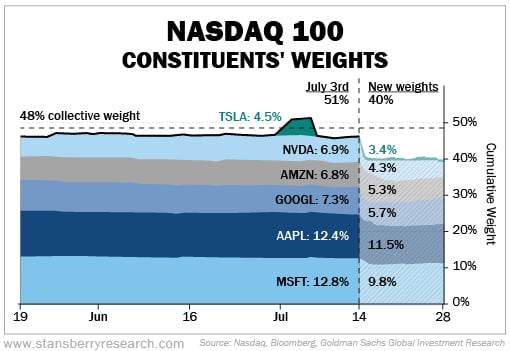
will look like after the rebalancing…
Among the most affected companies are Nvidia (NVDA) and Microsoft (MSFT), both of which will see their weights decrease by approximately 3 percentage points. The redistributed weight will be allocated to smaller caps within the index.
The rebalancing will take effect before the market opens on Monday, July 24, and it’s expected to have implications for both passive and active mutual funds benchmarked to the Nasdaq 100 Index. According to analysts at EPFR Global, approximately $251 billion in assets under management from passive mutual funds and exchange-traded funds are tied to the index.
Rebalancing events, especially when executed by passive funds, can create some level of market churn. However, the details of the rebalancing have been known since Nasdaq’s announcement on July 10. So the trading activity that has taken place since could lessen the chances of significant volatility.
In fact, during the previous week, the top seven Nasdaq 100 stocks outperformed the index, suggesting that traders and investors may have already factored in the rebalancing.
Also, when you look at previous special rebalances, it becomes clear that they tend to be uneventful in the long run.
For instance, a special rebalancing occurred in 2011 when Apple’s (AAPL) weight in the index reached an uncomfortable 20%. Despite the reallocation of a significant portion of Apple’s weight to Microsoft, there was no lasting effect on share prices. This precedent suggests that next week’s rebalancing is unlikely to have a profound impact on the overall market.
While events like these may cause some short-term market churn, history suggests that the effects from rebalancing tend to be temporary. But it’s still crucial for investors to stay informed on events like these and keep a closer eye on your portfolio..






 Options Bistro